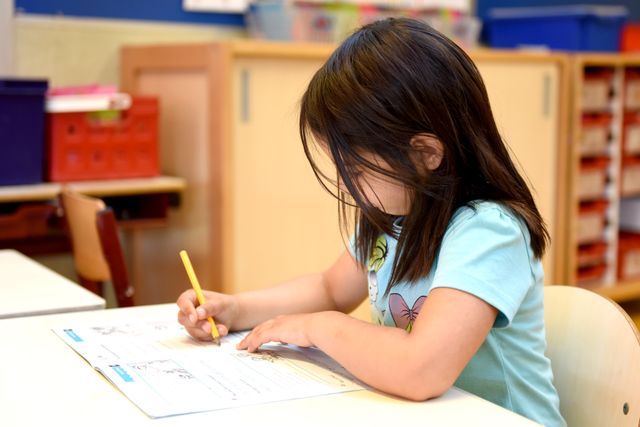
Why Alphabetical Order Fails Beginning Readers (And What to Teach Instead) — Free Printable

In a typical first-grade classroom, the first page a child meets is often a worksheet with a single letter at the top: A. Then, the next day, B. Then C. The child traces each one, in order, the way the alphabet has always been taught, one letter, one day, one shape at a time, moving steadily toward Z.
For weeks, nothing happens that looks like reading. The child can recite the alphabet song beautifully by the second week. But ask her to read a real word, and she has nothing to stand on. She has learned twenty-six shapes with twenty-six names. She has not yet learned that shapes make sounds, and sounds make words.
This is the gap that a program called Foundations of Print was built to close, not by tracing more, or tracing neater, but by teaching letters in a different order altogether.
Why Alphabetical Order Fails Beginning Readers
There is nothing sacred about A-B-C. It is a song, not a science. Alphabetical order was fixed centuries ago for the purpose of sorting, dictionaries, indexes, library shelves, not for the purpose of teaching a five-year-old how to read. Taught in that order, a child can usually recite all twenty-six letters within weeks, and still have no idea how to read a single real word, because nothing about A, B, and C combines quickly into anything she can sound out.
Foundations of Print teaches letters in a different sequence instead: s, a, t, p, i, n. Chosen not for how they sound together as a song, but for how quickly they combine into real, three-letter words a child can actually sound out: sat, pat, tap, pan, nap, tan, sap, pit, sit, tip, nip, pin, tin. Fourteen decodable words, built from just six letters, before a single additional letter is introduced.
The order also does something quieter but just as important: it keeps visually confusable letters, b and d, p and q, apart from each other in those early, wobbly weeks when letter reversal is most common. A child isn’t asked to hold two mirror-image shapes in mind at the same time before either one is secure.
What the Research Says About Learning to Read
Cognitive scientist Stevan Harnad described what he called the “symbol grounding problem”: a symbol learned in isolation, disconnected from meaning, stays exactly that, an arbitrary mark. Foundations of Print answers this directly. Every letter is introduced with its sound and folded into a real word from the very first session, never taught as a shape floating on its own.
David Ausubel’s account of meaningful learning adds the next piece. New material sticks when it connects to what a learner already knows (he called this progressive differentiation), and then gets put back to work alongside it (integrative reconciliation). That is exactly what happens when “a” and “t,” secure after two sessions, are folded into “tap” and “pat” rather than left sitting as isolated shapes waiting for the alphabet to finish.
Linguist Rebecca Treiman’s work on onset and rime, how children naturally hear “s-at” or “t-an” as chunks rather than three separate phonemes, shaped how the word-building pages are organized. And reading researcher Linnea Ehri’s account of the phases children pass through on the way to fluent word reading is the reason the whole module exists: the fastest way to move a child out of the earliest, most fragile phase of reading is to hand her real words she can actually decode, as early as possible.
David Share’s self-teaching hypothesis ties it together. Once a small set of letters is genuinely secure, a child given decodable words to sound out independently isn’t just completing an exercise. She is building her own sight-word vocabulary, one successful decoding attempt at a time, largely on her own.
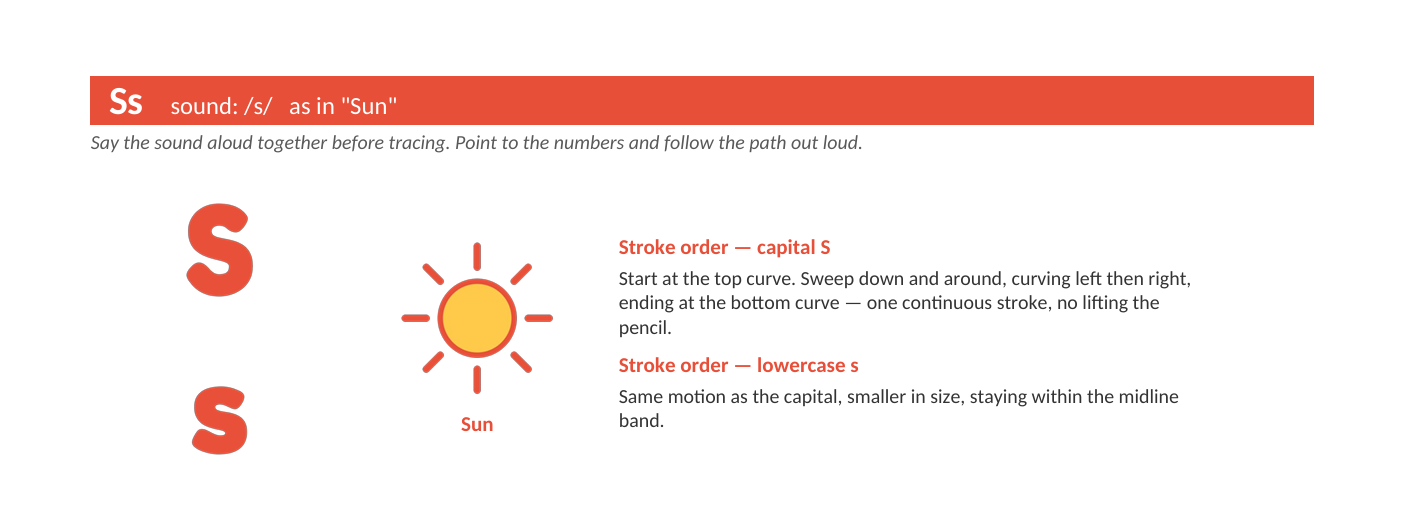
First-grade child tracing letters using phonics-based letter sequence worksheetTracing Was Never the Problem, Tracing Alone Was
Handwriting still matters. Virginia Berninger and Todd Richards’ research on the brain’s motor and language systems shows that letter formation which becomes automatic, rather than merely accurate, is what predicts fluent writing later on. But conventional tracing worksheets tend to offer identical support on every single line, the same dotted guide, page after page, with no sound attached and no word attached.
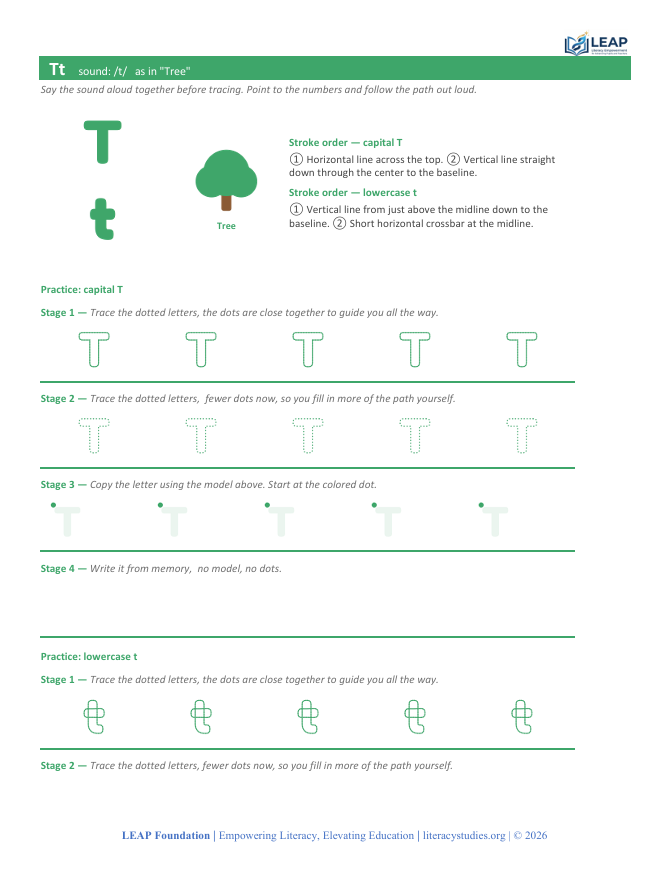
Foundations of Print instead moves each letter through four levels of support that fade on purpose:
Full Trace a complete, solid guide establishes the correct stroke path.

full trace child tracing letters using phonics-based letter sequence worksheetPartial Trace the guide thins, and the child supplies part of the motor sequence from memory.

partial trace child tracing letters using phonics-based letter sequence worksheetCopy from Model only a starting dot and baseline remain.

copy from model child tracing letters using phonics-based letter sequence worksheetIndependent Recall a blank line, and the child writes the letter from memory alone.

independent recall model child tracing letters using phonics-based letter sequence worksheetSupport is withdrawn deliberately, on the understanding that a motor skill only becomes durable once the scaffolding holding it up is taken away, not left in place indefinitely.
What’s Inside Module 1
Each letter page in the module follows the same “Say – See – Trace – Write” routine: the sound is said aloud before any pencil touches paper, the numbered stroke path is described in the child’s own words, Stages 1 through 3 are traced, and Stage 4 is written from memory before the letter is used in a real word. A four-line handwriting guide (ascender, midline, baseline, descender) teaches letter proportion from the very first page, so tall letters, round letters, and letters with tails are never treated as the same size.
One letter page plus its matching word-building section makes one session, roughly ten to fifteen minutes. A one-page fidelity checklist at the end lets teachers and parents track whether each session was delivered as designed, useful for classroom consistency and for anyone tracking outcomes over time.
child tracing letters using phonics-based letter sequence worksheetA Foundation, Not a Finish Line
Module 1 is a complete, standalone unit built around six letters: s, a, t, p, i, n. It is also, quite deliberately, a model. The same four-part structure, sound-first introduction, stroke-order guidance, the four-stage fading scaffold, and word-building practice, extends across three further modules covering the rest of the alphabet, sequenced so that b is introduced only once d is secure, and every new letter can immediately combine with letters already learned to build new, real words.
A child who finishes Module 1 hasn’t just learned six letters. She has learned, in the truest sense, how to read: sound by sound, word by word, with nothing handed to her that she couldn’t sound out herself.
Download the free printable, Foundations of Print: Module 1 (Letters s, a, t, p, i, n), below, and give your classroom or your child’s desk a letter sequence built for reading, not just for reciting.
References
Ausubel, D. P. (1968). *Educational psychology: A cognitive view.* Holt, Rinehart and Winston.
Berninger, V. W., & Richards, T. L. (2002). *Brain literacy for educators and psychologists.* Academic Press.
Dehaene, S. (2009). *Reading in the brain: The new science of how we read.* Viking.
Ehri, L. C. (1995). Phases of development in learning to read words by sight. *Journal of Research in Reading, 18*(2), 116–125.
Ehri, L. C. (2005). Learning to read words: Theory, findings, and issues. *Scientific Studies of Reading, 9*(2), 167–188.
Harnad, S. (1990). The symbol grounding problem. *Physica D: Nonlinear Phenomena, 42*(1–3), 335–346.
Joyce, B., Weil, M., & Calhoun, E. (2015). *Models of teaching* (9th ed.). Pearson.
Share, D. L. (1995). Phonological recoding and self-teaching: Sine qua non of reading acquisition. *Cognition, 55*(2), 151–218.
Treiman, R. (1985). Onsets and rimes as units of spoken syllables: Evidence from children. *Journal of Experimental Child Psychology, 39*(1), 161–181.
Treiman, R. (1986). The division between onsets and rimes in English syllables. *Journal of Memory and Language, 25*(4), 476–491.